
Reviewed · WALKING TOURS
Private 1.5-Hour Nightwatchman Walk in Medieval Lucerne
Lucerne at night feels like a time machine. This private 1.5-hour Nightwatchman walk pairs a local guide in costume with clear projector visuals, so you can actually follow the medieval story, not just hear it. I love the way you get modern views lined up with what used to be there, especially when the guide walks you through the Martiniplan (Lucerne’s first city map, dated 1597) and points out buildings that still match today. I also love the spooky-but-friendly legends and details, from the Water Tower’s grim backstory to the projected tales along the river. One heads-up: a few stops involve sights where admission tickets are not included, so check on-site what costs extra.
You’ll meet at Rosengart Platz (6004 Luzern) and take a relaxed, weather-proof style stroll through the Old Town, ending back where you started. Most days it runs about 1 to 1.5 hours, but in winter (November to March) it shortens to about 1 hour. This is ideal if you want a guided nighttime walk that feels local, with plenty of “wait, what is that?” moments along the way.
In This Review
- Quick hits you’ll care about
- Nightwatchman storytelling is a smart way to see Lucerne’s Old Town
- Starting at Peterskapelle, you learn the Martiniplan map trick
- Chapel Bridge and the Water Tower, two dates that explain the city
- Furrengasse to Kapellplatz, the city turns supernatural
- Kornmarkt and the town hall clock, medieval measurement and power
- Brandgässli and the riot, then the switch to the wine market
- Weinmarkt frescos and the broken-heart Latin line
- Im Zöpfli justice scenes, then the Reuss bridges and walls
- Alte Suidtersche Apotheke window and Ritterscher Palace’s Dance of Death
- Crossing back over Chapel Bridge, why it’s diagonal
- Price and value, what you get for $165.26 per person
- What to wear, and how to plan your night walk
- Who should book this Nightwatchman walk
- Should you book this private Nightwatchman walk?
Quick hits you’ll care about
- Private, costumed guide at night: a one-group-at-a-time walk, with medieval-style storytelling and props.
- Projector-based medieval explanations: you get visuals for key sites and street-level details.
- Martiniplan map spotlight (1597): you’ll see how today’s Old Town lines up with Lucerne’s earliest map.
- Landmarks plus legends: Chapel Bridge, the Water Tower, and fun supernatural stories like the Toggeli.
- Mural and architecture focus: murals, frescos, clocks, and unusual building features get explained in plain terms.
- Some stops may cost extra: several locations list tickets as not included, so budget a little wiggle room.
Nightwatchman storytelling is a smart way to see Lucerne’s Old Town
Lucerne’s Old Town is the kind of place where you can easily walk past something fascinating. At night, that risk is even higher, because the streets are darker and you have fewer chances to “scan and figure it out.” This tour fixes that with a guide who performs the role of a nightwatchman and turns the walk into a guided puzzle.
What makes it work is the mix: the guide uses a projector to show maps and images while you’re standing in the right spot, and then ties it back to the buildings around you. That means you spend less time guessing, and more time connecting the dots between medieval life and the exact stones in front of you.
Also, it’s a private format. That matters because you can ask quick questions in the moment, and the pacing stays comfortable for your group.
More Walking Tours in Lucerne
- Lucerne: Private Walking Tour with a Local Guide
★ 4.6 · 450 reviews - Lucerne Walking & Boat Tour: The Best Swiss Experience
★ 4.5 · 417 reviews - Lucerne: Guided Walking Tour with an Official Guide
★ 4.7 · 321 reviews
Starting at Peterskapelle, you learn the Martiniplan map trick
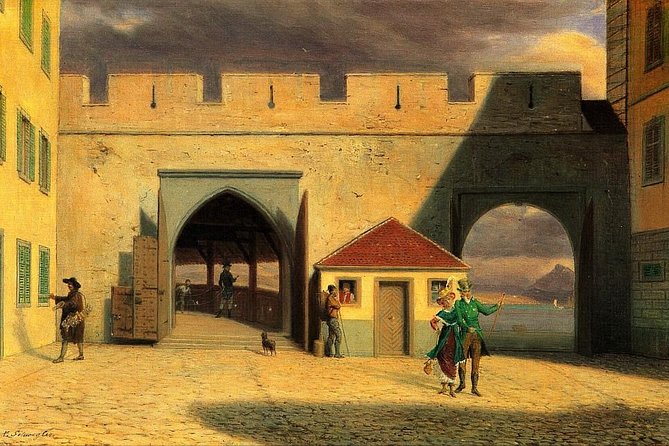
The tour kicks off at Peterskapelle (Peter’s Chapel). The nightwatchman-style entrance starts with a fire horn and a dramatic invocation pray, then the guide settles into the role with a projector.
This first stretch is where the tour earns its name for me, because it’s not only spooky atmosphere. You get a hands-on lesson in Lucerne’s earliest map, the Martiniplan from 1597. The guide shows the route on the map and helps you see how many buildings depicted back then still exist in the same places today. That one skill, seeing the city as an overlay, makes the rest of the evening click.
From there, you’ll look at St. Peter’s Chapel, described as the first church in town dating to the 12th century. Next to it, you’ll learn about a local “first” connected to a stone house and the origin of the phrase stone rich. Even if you’re not a museum person, this is the kind of story that makes the Old Town feel personal.
Practical note: this stop lists an admission ticket as not included, so if the chapel area you visit has an entry cost, plan for that.
Chapel Bridge and the Water Tower, two dates that explain the city
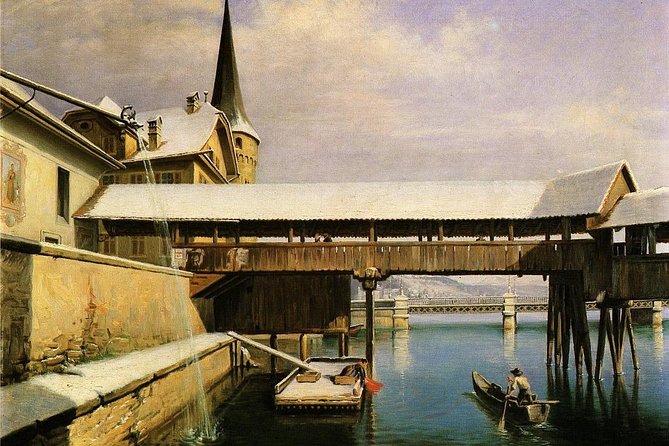
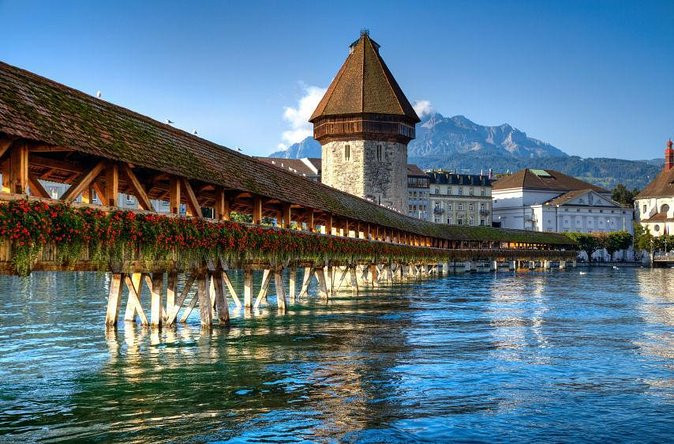
Next you head toward the Chapel Bridge and the nearby Water Tower. The guide sets up a simple timeline that’s easy to remember: the Water Tower dates to the late 13th century, while the Chapel Bridge is dated to 1365. Standing in the right spots at night helps these dates feel less like random facts and more like a city growing in layers.
You’ll also see projected images connected to the Water Tower’s interior, including references to a torture chamber, a dungeon, and a secret room. The point here is tone and context. This is Lucerne presenting the hard edge of medieval life, told in a way that’s more story than gore.
You’ll also learn where the Chapel Bridge got its name from, and you’ll end this segment with the bridge itself becoming more than a postcard. It turns into a clue about how Lucerne organized its world.
Furrengasse to Kapellplatz, the city turns supernatural
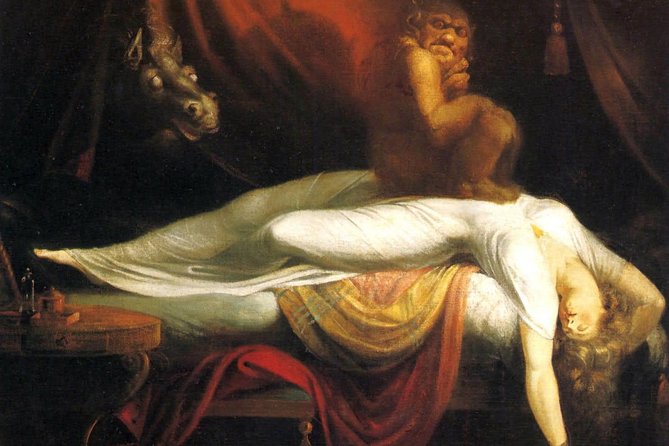
From there you walk around the corner into the old lane area near Kapellplatz, where the guide shifts from architecture to legend. At Furrengasse, you’ll hear about life in the Middle Ages through local lore, including a ghost story and the Toggeli, described as an incubus also called love robber.
Even if you’re skeptical about supernatural tales, I like this part because it shows what medieval stories were actually used for: warning, explaining, teasing, and giving people a shared language. In a city like Lucerne, where you’ll constantly see symbols and artwork on buildings, legends help you read what you see.
Most of these stops in this middle section list free entry, so it’s a good stretch when you want maximum storytelling for minimal extra cost.
A few more Lucerne days worth weighing up
- Exclusive Private Lucerne Walking Tour with Local Guide 3 Hours
★ 5.0 · 80 reviews - 1.5-Hour Small-Group Nightwatchman Walk in Medieval Lucerne
★ 4.5 · 34 reviews - Lucerne: Private Walking Tour with a Local Guide
★ 4.2 · 34 reviews - Lucerne Walking Tour: Explore Top Sights & Hidden Gems
★ 5.0 · 24 reviews
Kornmarkt and the town hall clock, medieval measurement and power
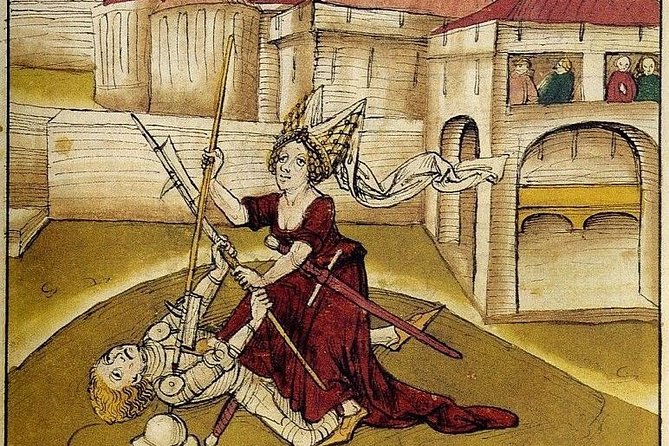
When you reach Kornmarkt (Town Hall Square), the tour leans into civic Lucerne. You’ll look at the Renaissance-era town hall and its tower, including a clock with no minute hand, which is exactly the kind of detail a normal stroll usually misses.
Then the guide adds another thread: the story of the Giant of Reiden, plus a look at Lucerne’s official measures, the Lucerne Foot and Elle. That might sound dry, but it’s actually a neat window into how medieval cities kept trade and order consistent. When you see physical standards built into a public square, you understand why governments cared about accuracy long before today’s measuring tools.
This stop also indicates admission tickets are not included, so if you plan to enter any part of the town hall complex, check what costs extra on the night you go.
Brandgässli and the riot, then the switch to the wine market
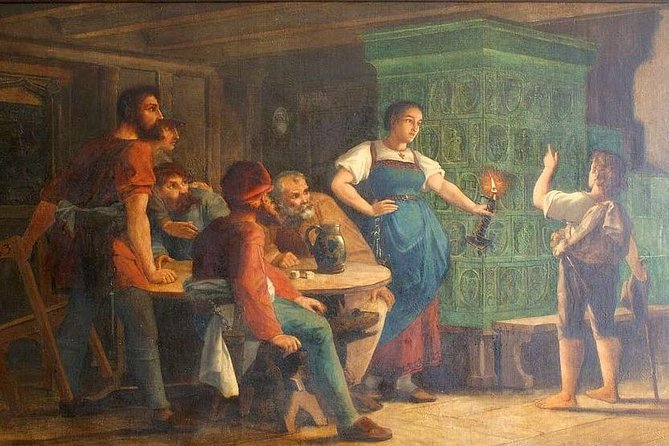
In the Brandgässli alley, you’ll hear about the Riot of Lucerne and then continue toward the former fish market area that’s known today as the wine market.
This is one of those transitions that helps you understand how Old Town spaces change jobs over centuries while the streets stay basically the same. The nightwatchman role keeps the story moving, so you’re not stuck listening to dates in a vacuum.
It’s also a good moment for a quick photo, because alleyways often frame medieval facades well even with low night lighting. Just remember: it’s a walking tour, so keep your pace in mind.
Weinmarkt frescos and the broken-heart Latin line
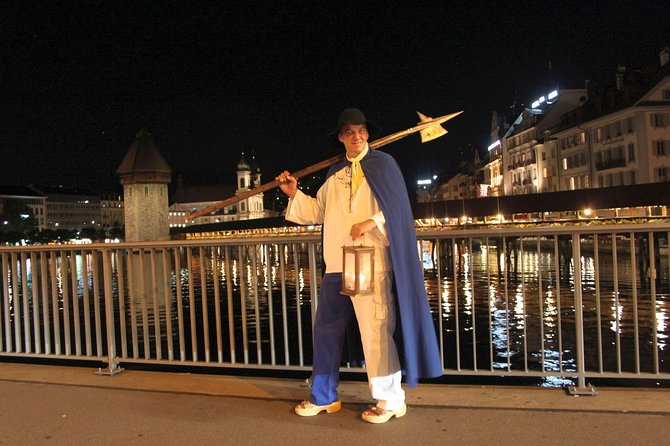
At Weinmarkt, you’ll see old guest house signs and admire frescos on houses. Then you’ll focus on the former pharmacy house of Renward Cysat, where you can read a Latin sentence: Amor medicabillis nullis herbis, explained as there is no cure for a broken heart.
That line works on two levels. First, it’s human, which makes medieval life feel less distant. Second, it connects the idea of medicine and love, which is exactly the kind of symbolic humor that shows up across European medieval art.
This stop lists the admission as free, so it’s a great place to linger with the guide’s explanations before moving on.
Im Zöpfli justice scenes, then the Reuss bridges and walls
At Im Zöpfli, you’ll hear about law and order in old Lucerne. The tour includes projected paintings about prosecution, interrogation, and corporal punishment in the Middle Ages in Lucerne.
This section has a weight to it. The guide doesn’t just say words, they connect the concept to what you’re seeing in the area. In practical terms, it helps you understand why certain squares and public spaces mattered in civic life.
From there you move to the river area and Reussbrücke, where you pass the bridge and see references to the Spreuerbrücke (Mill Bridge), the Needle Dam, and parts of the Musegg Wall. Even if you only catch fragments at night, the tour helps you place them in the city’s layout so you can recognize them later in daylight.
Most of these segments list free admission.
Alte Suidtersche Apotheke window and Ritterscher Palace’s Dance of Death
A little further along is the Alte Suidtersche Apotheke, known for its medieval pharmacy window. The guide calls it breathtaking, and the way the story is told makes it more than a pretty storefront detail.
Then comes a big finish. At Ritterscher Palace Lucerne, you’ll meet projected images and stories about guardian demons. You’ll stop at the legendary house of Lux Ritter and learn why the first two floors look different from the third one. After that you’ll hear about Hans von Trient, described as an unlucky stonemason.
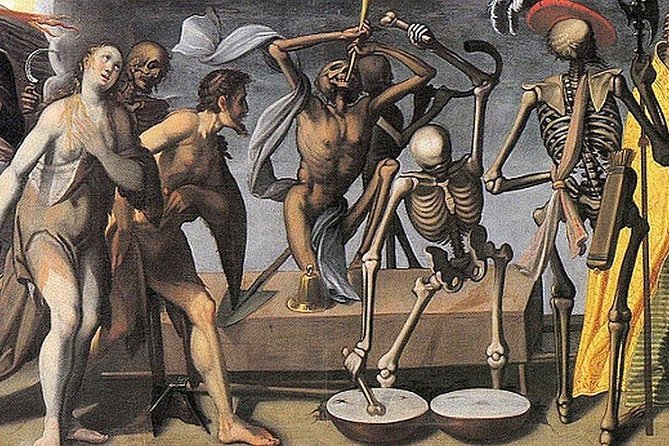
The biggest visual moment here is the Dance of Death. The guide presents seven paintings of the dance, with the pictures projected on a house wall so you can actually see what you’d otherwise miss in a nighttime street.
This segment also lists admission as not included, so again, budget a little flexibility if the palace-related viewing has any extra cost.
Toward the end, you’ll pass the Church of the Jesuits, noted as the first baroque building in Switzerland dating back to 1677. Even if you don’t go inside, it’s a good reminder that Lucerne keeps evolving, not freezing in one medieval snapshot.
Crossing back over Chapel Bridge, why it’s diagonal
Near the end, you cross the Chapel Bridge again. This time, the guide points out the bridge’s diagonal construction over the river, and you’ll see paintings connected to the bridge.
Then you reach the starting point, ending the walk back at Rosengart Platz.
This closing loop matters because it turns the bridge from a single landmark into a story arc. By the time you cross again, you’re primed to read symbols, dates, and building details that you would have missed earlier.
Price and value, what you get for $165.26 per person
At $165.26 per person, this is not a casual bargain hunt. But it also isn’t an all-museum day. You’re paying for a private guided experience, at night, with a performer in costume and projector visuals used while you walk.
In practical value terms, you’re buying:
- a guide who turns the street into a classroom with images (not just spoken directions)
- time efficiency, since the route strings together key medieval places in about 1 to 1.5 hours
- a storyline that connects multiple sites, from the Martiniplan map to the Dance of Death projections
If you’re comparing it to “self-guided nighttime wandering,” the difference is clarity. If you’re comparing it to a standard guided tour without special staging, the costume role plus the projection tech add something memorable.
If your group is comfortable paying for “guided plus theater-lite,” it often feels fair. If you prefer a free, flexible pace and plan to read on your own, this might feel expensive for what is essentially a walking route.
What to wear, and how to plan your night walk
This tour runs in all weather. That’s important in Lucerne, where evening conditions can shift fast. The guide-style walk is outside, and several stops involve looking up or toward walls for projected visuals, so you’ll want clothing that keeps you warm enough to stand still for short moments.
In winter (November to March), the duration shortens to 1 hour, so dress even more for cold. Bring a layer you can move comfortably in, and consider a small umbrella or rain shell if drizzle is likely.
Good news: it’s private and group size is limited to your party, so you’re not squeezed by a huge crowd.
Also, the tour is near public transportation, so you can build it into your Lucerne evening without stress.
Who should book this Nightwatchman walk
I think this works especially well if you:
- like medieval storytelling but don’t want it to feel like a lecture
- enjoy seeing how art and symbols on buildings connect to real life
- want a nighttime activity that feels different from the usual Chapel Bridge photos
- are visiting as a family that includes teens, since one of the standout pieces is that the guide keeps it fun while still covering real details
Based on past experiences with guides in the role, guides such as Rolf and Ralph have been praised for strong English, enthusiasm, and a unique style that mixes humor with solid local knowledge. If you care about lively delivery, this is your type of tour.
Should you book this private Nightwatchman walk?
Book it if you want a guided nighttime Lucerne experience that teaches you how to read the Old Town streets, not just where to stand for photos. The best reason is the pairing of projection visuals with exact locations, especially the Martiniplan map lesson and the Dance of Death projections.
Skip or reconsider if:
- you’re trying to keep costs very low
- you dislike night walking or cold weather (even with all-weather operation)
- you’re expecting everything to be free to enter, because several stops list admission tickets as not included
If you’re on the fence, here’s the simplest decision rule: if you’d rather have someone point out what matters in the dark, this tour will feel worth it. If you’d rather explore at your own speed and read every sign yourself, you can still do Lucerne on your own, but you’ll miss the guided links that make the city snap into focus.
Newly reviewed around Lucerne
- Zurich: Adventure to Lucerne & Pilatus Gold or Silver tour★ 4.8 · 8 reviews
- Private Transfer: Lucerne to Zurich Airport ZRH by Business Car★ 5.0 · 11 reviews
- Private Transfer: Lucerne to Zurich Airport ZRH by Luxury Van★ 4.5 · 6 reviews
- The Lives and Legends of Lucerne: A Self-Guided Audio Tour★ 5.0 · 6 reviews
- Walking Tour – Around the Old Town Lucerne★ 3.5 · 3 reviews
- Touristic highlights of Lucerne on a Private half day tour with a local★ 4.0 · 5 reviews
- Natural Wonders of Switzerland from Lucerne (1 Day Private Tour)★ 5.0 · 21 reviews
- Revealing Lucerne: Self-Guided Audio City Tour★ 4.0 · 20 reviews
Walking Tours, compared.

Zurich Walking Tour With Cruise and Aerial Cable Car
Read our review →

Lucerne Walking & Boat Tour: The Best Swiss Experience
Read our review →

3 in 1: Zurich Walking Tour – Cruise on the Lake – Cable Car Ride to Felsenegg
Read our review →Browse the lists this tour appears in