
Reviewed · WALKING TOURS
Zermatt 2-Hour Small Group Village Walk
Matterhorn stories fit into two hours. I love the small-group size and the way the route mixes classic sights with quieter side streets, ending at a real photo stop at Kirchbrücke. One thing to plan for: the walk is tightly timed, and if weather clouds the Matterhorn, your best views may be brief.
In my book, this kind of Zermatt walk is the fastest way to understand the place without burning a whole day. You get a local guide perspective, and you can see that in how guides like Abraham, Remi, Tony, and Mike handle questions, photos, and route pacing. Plus, Zermatt is car-free, so the whole village reads like a walkable museum.
The village scenes change with the seasons, and that matters here. One stop even points out the tennis court that becomes a natural ice rink in winter, which is exactly the sort of detail you miss if you only follow the main shopping drag.
In This Review
- Key Highlights You Will Actually Feel During the Walk
- Zermatt in Two Hours, Without Getting Trapped in the Main Streets
- Meeting at Bahnhofplatz, Where Zermatt Begins (Train Station Logic Included)
- Bahnhofstrasse: The Shopping Street, Then a Left Turn Into Real Quiet
- Gourmetweg: Tennis Courts, Winter Ice, and Architecture From Two Eras
- Hinterdorfstrasse: Old Zermatt, Flat-Stone Rooftops, and Alleyway Secrets
- Monte Rosa Hotel: Where Matterhorn Tourism Took Off
- Mountaineers’ Cemetery: A Necessary Human Moment
- Kirchbrücke Bridge Viewpoint: Getting the Classic Matterhorn Photo (With Weather in Mind)
- Uferweg Along the Vispa River: The Calmer Ending Back Toward Sunnegga and the Station
- Price and Value: Is $140.55 Worth It for a 2-Hour Walk?
- How Guides Really Make This Tour Work
- Who This Tour Fits Best, and Who Might Prefer Something Else
- Should You Book the Zermatt 2-Hour Small Group Village Walk?
- FAQ
- How long is the Zermatt village walk?
- Where do I meet, and where does the tour end?
- Is the tour offered in English?
- What is the maximum group size?
- Does the tour need good weather?
- What is the cancellation window?
- Are children and service animals allowed?
Key Highlights You Will Actually Feel During the Walk
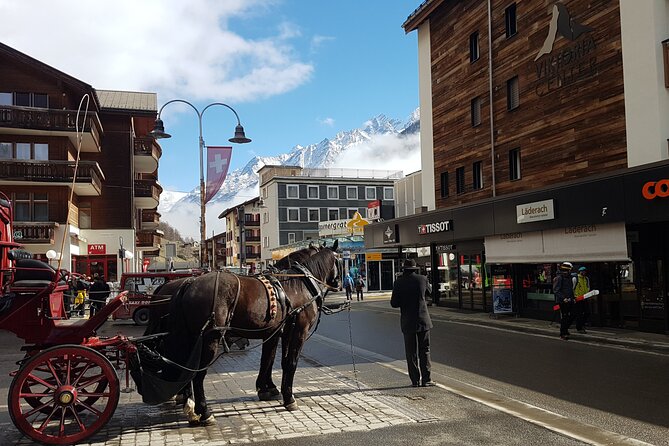
- Max 15 travelers keeps questions going and the pace friendly
- City-to-old-town route helps you understand what came first in Zermatt
- Flat-stone roof details plus centuries-old buildings make the architecture click
- Matterhorn climbing stories connect landmarks to the mountain’s human history
- Kirchbrücke bridge viewpoint is built for the classic Matterhorn photo
- Vispa river walk back gives you a calmer, scenic ending near the cable car area
Zermatt in Two Hours, Without Getting Trapped in the Main Streets
Zermatt can feel like it has two speeds. There is the crowded shopping zone, full of postcard energy, and then there is the slower, older fabric of the village where people actually live and work.
This walk is designed to give you both. You start right at Bahnhofplatz, then move through Bahnhofstrasse, but you do not stay there long. The plan is to get you oriented first, then gradually steer you away from the loudest parts of town. That is why small groups matter. A guide can read your questions and adjust on the spot, which is what you hear again and again from guides like Remi and Tony.
Also, the timing is realistic. The tour is about 2 hours, and the stops add up to a steady rhythm rather than a string of rushed picture breaks. You will still want comfy shoes, because this is a walking tour in a compact medieval village, but the pace is meant to be manageable for most people.
A few more Zermatt days worth weighing up
- Zermatt Village Walk and Mt. Gornergrat Private Day Trip
★ 4.5 · 12 reviews - Zermatt Village Walk and Mt. Gornergrat Private Day Trip
★ 5.0 · 7 reviews - Zermatt Village Walk and Glacier Paradise Private Day Trip
★ 5.0 · 4 reviews
Meeting at Bahnhofplatz, Where Zermatt Begins (Train Station Logic Included)
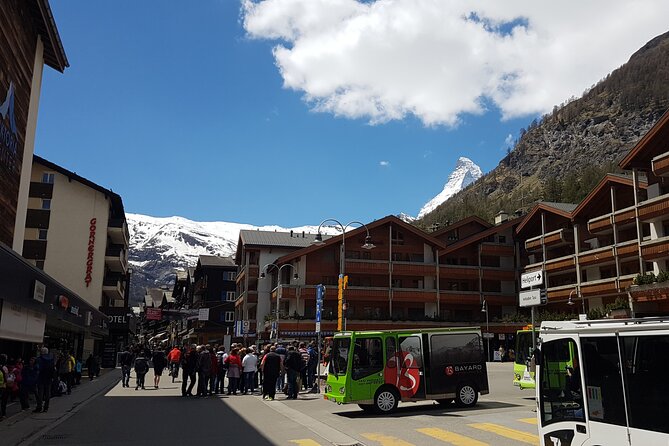
You meet at the Zermatt Tourist Information Center at Bahnhofpl. 5. The guide starts at the station entrance area because it is not just a practical meeting point, it is the gateway to the whole town.
Why that matters: Zermatt is one of those places where access shapes everything. The station is the only practical way for both travelers and goods to reach Zermatt, so the village developed around that flow. When your guide explains this early, the rest of the streets stop feeling random. You start to see why shops, hotels, and old lanes sit where they do.
This first stretch also helps you get a quick sense of direction. If you are arriving on a train for your first time, you will appreciate that grounding. Even guides who start by sitting you down briefly with a map do you a favor: you leave the meeting point already knowing where you are headed.
Bahnhofstrasse: The Shopping Street, Then a Left Turn Into Real Quiet
Your second stop is Bahnhofstrasse, Zermatt’s best-known shopping street. For about 10 minutes, you get the big-picture view. It is a useful warm-up, because once you understand the main axis, the side streets feel easier to navigate later.
Then the route does something smart. You turn left, away from the heavy tourist flow and toward less obvious corners. That switch is not about avoiding people for the sake of it. It is about changing what you notice. On the quieter lanes, you catch details in building style, rooflines, and small architectural quirks that disappear when crowds are pressing you forward.
If you like street-level travel, this is the part that makes the tour feel worth it. A good guide turns a simple walk into a guided way of seeing.
Gourmetweg: Tennis Courts, Winter Ice, and Architecture From Two Eras
At Gourmetweg, you get a seasonal detail that is genuinely memorable. The area includes a tennis court that turns into a natural ice rink in winter. That is a small line in the description, but it is the kind of local adaptation that makes Zermatt feel alive rather than staged.
You also spot the mix of old and newer Zermatt here. The walk highlights modern architecture from newer buildings alongside the village’s traditional look. In plain terms, it helps you understand that Zermatt did not freeze in time. It kept growing, especially as tourism and mountain sports evolved.
This stop is about 10 minutes, which is perfect. You get the idea without getting stuck studying facades too long. If you arrive in winter, you may see hints of how the rink works. If you arrive in summer, you still get the story and the contrast.
More things to do in Zermatt:
- Zermatt: Gornergrat Railway Cogwheel Train Ticket
★ 4.7 · 580 reviews - Private Ski Lessons – 3 hours Zermatt
★ 5.0 · 279 reviews - Matterhorn Paragliding flight in Zermatt (20-25min)
★ 5.0 · 207 reviews - FLYMATTERHORN VIP Paragliding from Zermatt, With Matterhorn View
★ 5.0 · 192 reviews
Hinterdorfstrasse: Old Zermatt, Flat-Stone Rooftops, and Alleyway Secrets
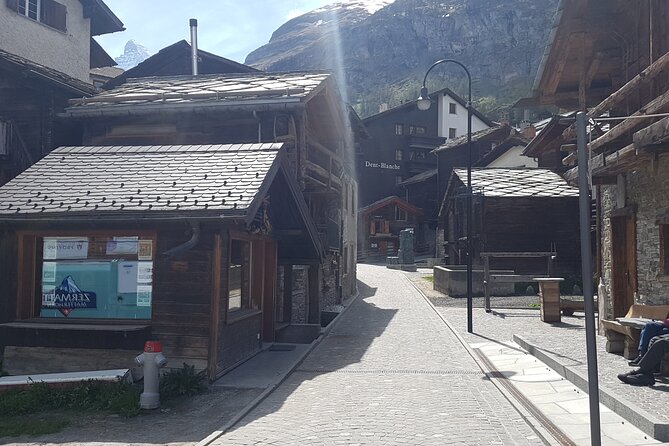
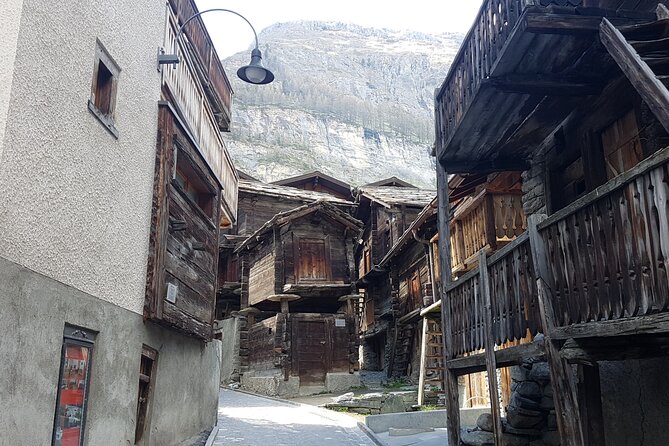
This is one of the most important segments: you enter the old part of Zermatt along Hinterdorfstrasse for about 20 minutes. Here, the tour shifts from orientation to discovery.
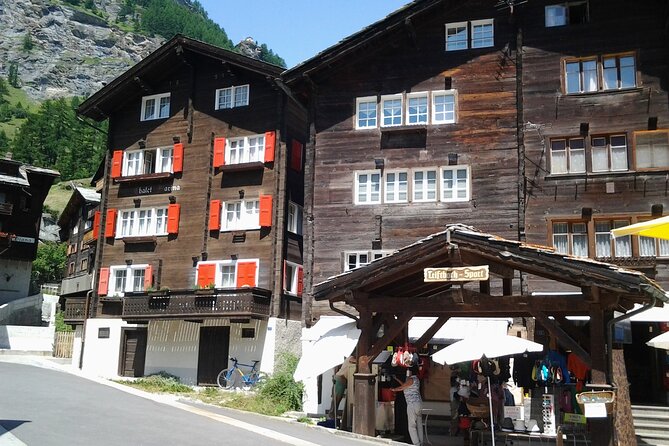
You get a guided look at how buildings were constructed centuries ago. The standout detail is the secret of the flat-stone rooftops. That is the sort of information that sounds niche until you are standing in front of it. Once your guide explains the logic behind roof style, you start noticing patterns in the surrounding buildings immediately.
You also pass barns said to be over 200 years old, plus small alleyways that cut through the village like shortcuts. Those lanes are what make Zermatt feel like more than a shopping postcard. They show you how people moved and stored supplies long before today’s tourism machines.
A quick practical note: alleyways can mean uneven footing. Nothing extreme is mentioned, but if you are carrying camera gear or you have sensitive knees, take your time on this part.
Monte Rosa Hotel: Where Matterhorn Tourism Took Off
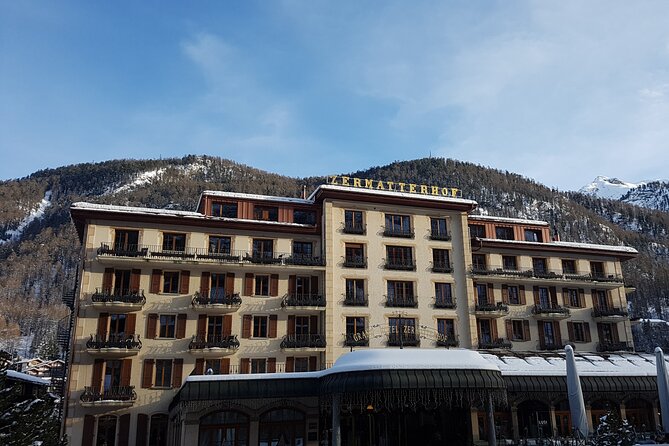
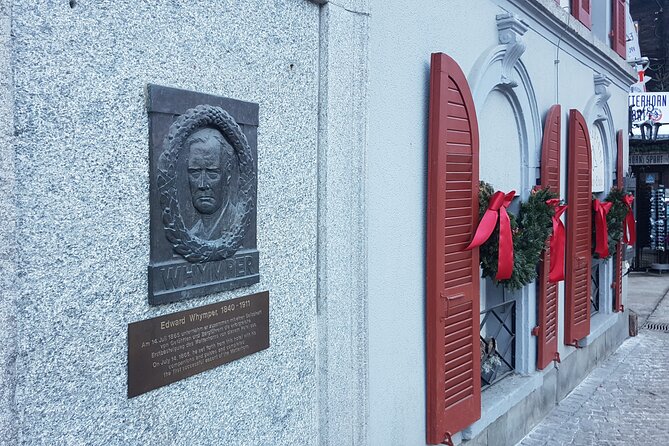
At Monte Rosa Hotel, you get a stop that connects buildings to climbing history. The walk explains that this is where the tourist growth of Zermatt began, and you hear insights into the early ascent story related to the Matterhorn.
Why I like this stop: it reframes the town’s grandeur. Instead of treating Zermatt as just a pretty place to sleep and shop, your guide shows you how the village became a base for alpine ambition. You understand why hotels, guides, and transport developed the way they did.
It is about 10 minutes, so you will not get lost in details. Still, the payoff is real. Even if you are not a climber, knowing how the town’s identity formed makes your later sightseeing feel smarter.
Mountaineers’ Cemetery: A Necessary Human Moment
Then the tour takes you to the Mountaineers’ Cemetery for around 15 minutes. This is not a “cute photo spot.” It is a sobering walk through the cemetery of mountaineers, including those who did not succeed climbing the Matterhorn or nearby alpine peaks.
A lot of Zermatt tours try to keep things upbeat the whole time. This one does not. And honestly, that is part of what makes it feel balanced. The Matterhorn is famous, but the mountain also has costs. Seeing that in a quiet cemetery setting adds weight to the climbing stories you have heard elsewhere.
If you are sensitive to this kind of topic, you can still appreciate it as context. If you are the type who likes your travel emotional and real, this stop will likely be one of your favorites.
Kirchbrücke Bridge Viewpoint: Getting the Classic Matterhorn Photo (With Weather in Mind)
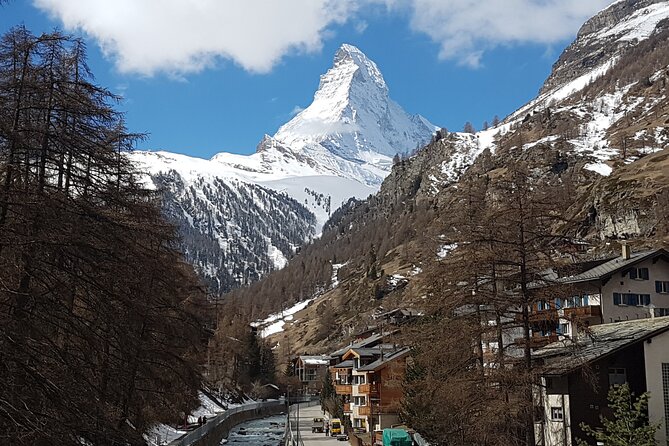
At the viewpoint near Kirchbrücke bridge, you get the typical Zermatt picture with the Matterhorn in the background. The stop is about 15 minutes, which is enough time to position yourself without feeling rushed.
One practical consideration: the Matterhorn is weather-dependent. Clouds can slide in quickly, and you might end up with partial views. That does not mean the stop is wasted. Even a partial silhouette or a break in the clouds can create a satisfying photo, and your guide can point out where visibility tends to look best from the area.
You are not just standing there either. Your guide keeps the story thread going, so this feels like a chapter ending rather than a random photo break. And because the group is small, you have an easier time stepping aside for shots without fighting the flow.
Uferweg Along the Vispa River: The Calmer Ending Back Toward Sunnegga and the Station
The final stretch is a 30-minute walk along Uferweg, following the Vispa river. This part shifts the mood again, from old streets and climbing lore to a more relaxed scenic return.
You pass hotels and newer apartment buildings, which quietly reinforces the old-versus-new theme you saw earlier. You also walk by the Sunnegga cable car station. That is useful context because Sunnegga is a common jump-off for Matterhorn-area experiences, and seeing it during your village orientation can help you plan next.
Then the walk heads back along Getwing street to the train station, where the tour ends back near the meeting point. By the time you reach the station again, you should feel like you understand where Zermatt’s main features connect.
In a place where everything is walkable but still easy to get turned around, that loop matters. You finish where you started, but with a clear internal map now.
Price and Value: Is $140.55 Worth It for a 2-Hour Walk?
At $140.55 per person for about 2 hours, this is not the cheapest thing you can do in Zermatt. But it also is not a long excursion where you pay for travel time and logistics.
Here is why I think it can still be good value for the right traveler:
- You get a licensed local guide style experience that focuses on history, culture, architecture, and mountain climbing context rather than generic sightseeing.
- The tour is small group capped at 15, which often makes it feel more personal and less like you are herded through stops.
- The walk covers a smart cross-section of town, so you get old Zermatt, newer buildings, and at least one iconic viewpoint in a short window.
The best value use case is your first full day in Zermatt, when you want quick orientation. Several guides also act like helpful problem-solvers, including working with your questions and even helping with nearby planning ideas after the walk. The more you engage, the more you get out of the $140.55.
How Guides Really Make This Tour Work
The itinerary gives you the structure, but the tone comes from the guide. Across the guide styles you will see mentioned, a few traits pop up: open questions, frequent photo stops, and a knack for making local lore feel understandable.
Guides such as Abraham and Remi are described as especially friendly and responsive. Tony and Mike are described as professional, flexible with pacing, and able to explain the town in clear English. In some cases, people even describe the tour as feeling intimate, such as when the group ended up very small.
That matters because Zermatt is the kind of place where details reward attention. A guide who can slow down for your questions at the flat-stone rooftops or switch pace for your camera rhythm turns the walk into something more than a checklist.
Who This Tour Fits Best, and Who Might Prefer Something Else
This tour fits best if you:
- are on a short schedule and want a fast orientation to Zermatt
- care about architecture, small-town history, and climbing stories tied to real locations
- like walking with a guide rather than self-guided wandering
- prefer smaller groups, so questions do not get lost
It may not be the best match if you:
- need a slower pace with lots of sitting time
- want long stretches of free time to explore on your own without guide prompts
- are traveling in conditions where you expect significant weather disruption, because this experience requires good weather
Should You Book the Zermatt 2-Hour Small Group Village Walk?
I would book it if you want the Matterhorn to feel connected to real places, not just a distant backdrop. The route is compact but thoughtful, and the stops cover the village in a way that makes later wandering easier. The combination of old Zermatt details, climbing-era context, and a viewpoint that targets the classic photo makes it a strong first-day plan.
If you are price-sensitive, consider whether you will actually use a guided explanation. If you mostly want scenery with minimal talking, a self-guided stroll might be cheaper. But if you want your time in Zermatt to turn into knowledge and sharper decision-making for what to do next, this is a solid way to get there fast.
FAQ
How long is the Zermatt village walk?
The tour lasts about 2 hours.
Where do I meet, and where does the tour end?
You meet at Zermatt Tourist Information Center, Bahnhofpl. 5, 3920 Zermatt, Switzerland, and the tour ends back at the meeting point.
Is the tour offered in English?
Yes, it is offered in English.
What is the maximum group size?
The tour has a maximum of 15 travelers.
Does the tour need good weather?
Yes. This experience requires good weather. If it is canceled due to poor weather, you will be offered a different date or a full refund.
What is the cancellation window?
You can cancel for a full refund up to 24 hours in advance.
Are children and service animals allowed?
Service animals are allowed, and children must be accompanied by an adult.
Newly reviewed around Zermatt
- Zermatt Village Walk and Mt. Gornergrat Private Day Trip★ 5.0 · 7 reviews
- Zermatt to Glacier Paradise Small Group Half-Day Trip★ 4.4 · 6 reviews
- Zermatt: Tandem Paragliding Flight – Best Matterhorn Views★ 5.0 · 47 reviews
- Zermatt’s Alpine Charms – Private Guided Village Tour★ 5.0 · 3 reviews
- Zermatt: Private Night Spa★ 5.0 · 3 reviews
- Zermatt & Mt. Gornergrat Small Group Day Trip from Bern★ 4.6 · 9 reviews
- Zermatt: Paragliding Tandem Flight★ 4.9 · 41 reviews
- From Basel: Zermatt and Mt. Gornergrat Tour★ 4.9 · 14 reviews
Walking Tours, compared.
Zurich Walking Tour With Cruise and Aerial Cable Car
Read our review →
Lucerne Walking & Boat Tour: The Best Swiss Experience
Read our review →
3 in 1: Zurich Walking Tour – Cruise on the Lake – Cable Car Ride to Felsenegg
Read our review →Browse the lists this tour appears in