
Reviewed · CITY TOURS
GENEVA EXCLUSIVE Complete Tour (PICK-UP), UN area & Old City
Geneva teaches peace with every stop. In this private 3 to 4 hour tour, you get picked up near the UN area at Place des Nations and then cover Geneva’s major highlights, from world organizations to the historic core, with an English guide in an air-conditioned vehicle. I love that you get real context, not just names and dates, especially around the UN campus. I also like the practical pacing, quick photo breaks, and the built-in time for Swiss treats, including the Swiss Chocolate Corner and a chance to buy a customized Victorinox.
comfortable shoes matter because you’ll walk about 2 hours across parks and Old Town streets, and umbrellas are not included.
In This Review
- Key things that make this Geneva tour worth your time
- Geneva by air-conditioned car, then feet on Old Town streets
- Place des Nations to UNHCR, where the story begins
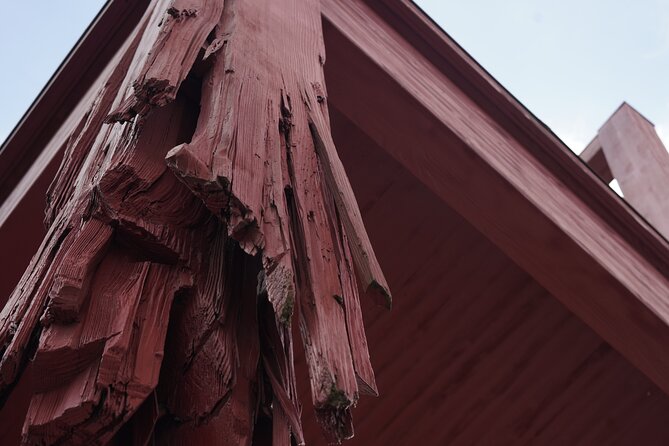
- The League of Nations legacy and the wooden Broken Chair
- WHO, labor rights, and the Red Cross museum connection
- Chambesy viewpoint: Mont Blanc and Lake Geneva photos, with a breather
- Manor Geneve stop and the Swiss Chocolate Corner reset
- Victorinox Flagship Store Geneve: your custom knife or watch moment
- Place de Neuve, Parc des Bastions, and the Reformation Wall
- Banc de la Treille: the famous long bench with big views
- Maison Tavel and Saint-Pierre Cathedral for the classic Old Town feel
- L’Horloge Fleurie by Lake Geneva, plus Place du Molard and luxury streets
- Monument National: finishing with Swiss confederation symbolism
- Price, pacing, and practical tips for a smooth half-day
- Should you book this Geneva UN and Old City tour?
Key things that make this Geneva tour worth your time
- UN area stops with names that actually matter: UNHCR, League of Nations legacy, labor rights, global health, and Red Cross context
- Broken Chair in Place des Nations: a 12 meter wooden symbol tied to peace and anti-personnel mine victims
- Chambesy viewpoint: a high point for Alps views and classic photos over Lake Geneva
- Shopping breaks that fit the route: Swiss chocolate at Manor Geneve and a Victorinox flagship store stop on Rue de Marché
- Old Town on foot without the chaos: Reformation Wall, Banc de la Treille, Saint-Pierre Cathedral, L’Horloge Fleurie, and more
Geneva by air-conditioned car, then feet on Old Town streets
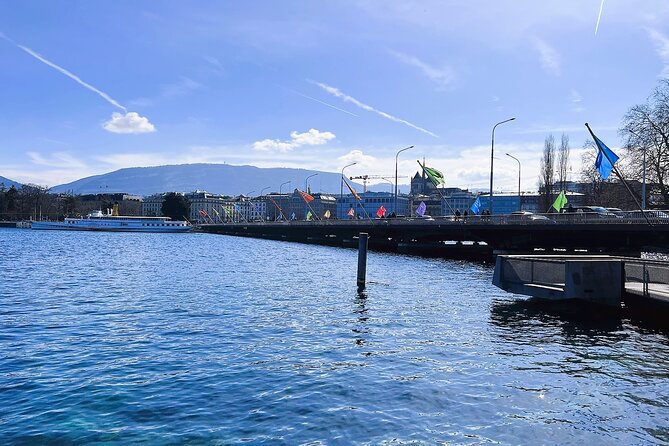
Geneva is one city with two very different moods. This tour starts in the calmer, official world of the UN area, then shifts into the tighter lanes and viewpoints of the Old City. The key for me is that you are not stuck guessing how all the pieces connect. The guide explains why these places exist, what they were for, and how Geneva became central to international work.
You also get a very practical setup: private transportation, bottled water, and a guided walk component. The tour is designed for a short window in the city. If you’re only here for a few days, this kind of orientation can save you time later, when you want to return to the corners you liked most.
One more plus: it’s truly private. That means the guide can set the pace for your group, whether you want more photos, more walking, or more time at the shopping stops. In the reviews, this flexibility is a big part of why people feel taken care of, including families who needed extra patience with kids and breaks for food.
More things to do in Geneva:
- Geneva: 50-Minute Lake Geneva Cruise
★ 4.3 · 4,063 reviews - Award-Winning Geneva Chocolate &Old Town Tour with Boat Ride (3h)
★ 5.0 · 3,721 reviews - Geneva: Scenic Lake Cruise with Snacks and Wine
★ 4.4 · 1,503 reviews
Place des Nations to UNHCR, where the story begins
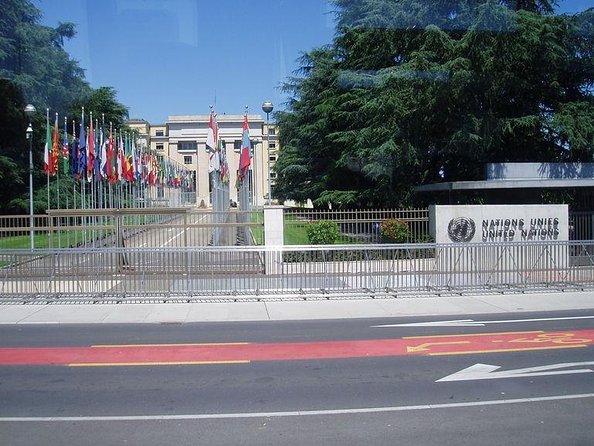
The tour meeting point is Place des Nations, right in the heart of the UN campus area. From the start, you’re in the part of Geneva that people often only see from outside. Here you get a guided look at institutions that deal with refugees and displacement, including the United Nations High Commissioner for Refugees (UNHCR).
What I like about starting here is that it gives you an anchor before you move into the Old City. Geneva isn’t only pretty stone and chocolate. It is also a working city with a global role, and the tour sets that up fast.
At these early stops, expect short, focused explanations rather than long lectures. The vibe is practical: you learn enough to understand why each building matters, then you’re back on your way. That matters on a half-day tour, especially if your goal is both learning and enjoying the city.
The League of Nations legacy and the wooden Broken Chair
Next up is the League of Nations headquarters history, which is now part of the UN story. The tour highlights how the League of Nations became the UN’s European center, with the Palais des Nations era following after 1946. This is the kind of context that makes later sightseeing clicks in your mind.
Then comes one of Geneva’s most recognizable peace symbols: Broken Chair in Place des Nations. The details are what make it memorable. It’s made entirely of wood, stands about 12 meters tall, and it’s dedicated to the victims of anti-personnel mines. Even if you don’t know the specific campaign history, seeing the scale and learning the message makes the stop more than a photo moment.
This is also a stop where timing works for most people. The tour gives you just enough time to look closely, take pictures, and move on, without turning it into an endurance test.
WHO, labor rights, and the Red Cross museum connection
Geneva has a rare concentration of international organizations, and this tour makes them easier to understand by linking them together thematically.
You’ll hear about organizations focused on:
- Labor issues with the ILO connection (founded in 1919, tied to the Treaty of Versailles and workers’ rights expansion)
- Global health prevention and intervention through the WHO, including the fact that the first meeting took place in Geneva in 1948
- The Red Cross legacy, tied to Geneva as its founding place and noted for earning three Nobel Peace Prizes in the 20th century
I like this format because it turns the UN campus from a bunch of big names into a connected system. You can walk through Geneva later and remember why that institution is there, and what kind of work it represents.
A realistic note: these are mostly exterior or orientation-style stops. If you were hoping for a deep, inside-only museum marathon, this isn’t that kind of day. It’s an efficient “get the meaning first” tour, which is usually the smarter choice when time is limited.
A few more Geneva days worth weighing up
- Best of Geneva City Tour: International Area and Old Town
★ 4.0 · 499 reviews - Best of Geneva City Tour with optional boat cruise
★ 4.0 · 416 reviews - Geneva: City Pass with 60 Activities
★ 4.1 · 323 reviews - Geneva: Annecy, the Venice of the Alps and Geneva City Tour
★ 4.5 · 189 reviews
Chambesy viewpoint: Mont Blanc and Lake Geneva photos, with a breather
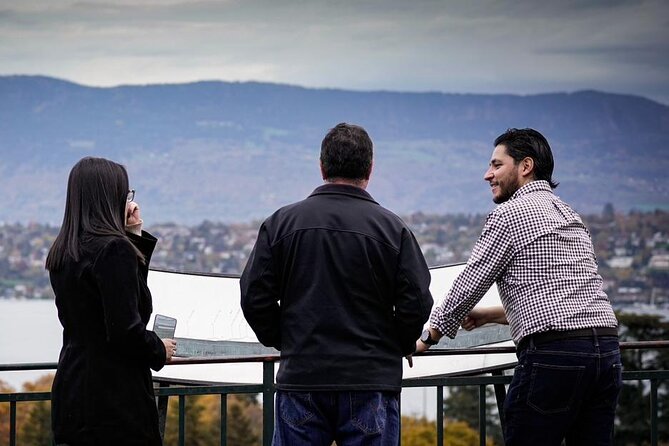
After the UN area, the route climbs toward Chambesy, in Pregny-Chambesy. This is where the tour slows down for views. The guide takes you to a beautiful high point where you can appreciate the Alps, including Mont Blanc (when conditions allow), plus Lake Geneva from its western shore.
Even if you’ve seen postcard photos before, the view from up there feels different. It’s wide, it’s airy, and it helps you understand Geneva’s geography. You start to see why people love walking by the lake and why the city is packed into its particular shape.
This is also a good mental reset after the institutional buildings. In a half-day tour, having a viewpoint break that isn’t just another street corner makes the whole experience feel balanced.
There’s also mention of the Ceramic and Glass Museum in this area, noted for having nearly 20,000 objects from the last 1,200 years. The tour gives context around what this museum holds, so even if you do not plan to enter, you’ll know what you’re looking at and why it’s famous.
Manor Geneve stop and the Swiss Chocolate Corner reset
Then you get your first true “Geneva pleasure break”: a stop at Manor Geneve. The tour allows a short refreshment window and includes time to visit their Swiss chocolate setup, specifically the complete Swiss Chocolate Corner.
This is a small detail, but I think it matters. Geneva can feel expensive and efficient. Having a planned stop where you can snack, warm up (or cool down), and buy a meaningful edible souvenir makes the tour feel more like a day out, not a checklist.
If you’re the kind of traveler who wants one safe souvenir that you’ll actually enjoy later, chocolate is a good bet. And if your group includes people who just want something simple while others listen to history, this stop keeps everyone happy.
Victorinox Flagship Store Geneve: your custom knife or watch moment
After the Manor break, you continue toward the city center and then land at the Victorinox Flagship Store Geneve on Rue de Marché. Here’s where the tour becomes more than sightseeing.
You get the chance to purchase a customized original Swiss Army Knife or a beautiful Swiss watch. The store itself is part of the experience because it’s one of the few Victorinox flagship stores in the world, and the brand is 138 years old.
If you’ve never bought a Swiss Army Knife before, this is a good place to do it. You can connect the souvenir to the tour theme, since Geneva is so tied to manufacturing and global reputation. Just don’t leave it too late in the day if you want time to browse and compare.
Place de Neuve, Parc des Bastions, and the Reformation Wall
Now the tour shifts fully into the Old City story. At Place de Neuve, you get a quick view of major landmarks such as the Opera House, the Grand Théâtre, the Geneva Conservatory of Music, and the bust of Henry Dunant. You’ll also see the old city wall and the entrance to Parc des Bastions, your next walk area.
Inside Parc des Bastions is the International Monument of the Reformation, generally known as the Reformation Wall. This stop is a strong example of how Geneva mixes faith, politics, and public art. The wall is about 99 meters long and 9 meters high and it’s attached to a part of ancient walls built in the 16th century. The monument honors major figures like Jean Calvin, Guillaume Farel, Théodore de Bèze, and John Knox.
What makes this stop work is scale. Even in a short visit, you can feel the intention. You’re not just reading about the Reformation. You’re standing in a place where that movement is literally carved into the city’s walls.
Banc de la Treille: the famous long bench with big views
From the Reformation Wall area, you’ll reach Banc de la Treille, the huge green bench built in 1767. It’s around 120 meters long and is noted as a Guinness record for the world’s largest bench.
This stop is quick, but I’d call it the tour’s “fun photo” moment. The bench sits above Parc des Bastions and near the entrance of the Old City, so you get both the quirky Geneva landmark and a great angle for pictures.
It’s also one of those spots where you can just pause for a minute and take in the mood. Geneva has plenty of serious places, and this gives you a lighter one.
Maison Tavel and Saint-Pierre Cathedral for the classic Old Town feel
As you continue, the tour passes Maison Tavel, described as the oldest private residence in Geneva still standing. It’s an important medieval reference point, and the story is clear: it was destroyed by fire in 1334, rebuilt by the Tavels family, later restored after the city acquired it in 1963, and now functions as a museum across 6 floors.
Inside Maison Tavel, the highlight mentioned is the largest model of Switzerland, about 30 square meters, called Le Relief Magnin. It reconstructs Geneva before demolition of fortifications in 1850.
Even if you don’t enter, this stop gives you a sense of how deep the city’s layers go. Geneva’s Old Town is not only pretty. It’s historically dense, and Maison Tavel helps you feel that without turning your day into a long museum slog.
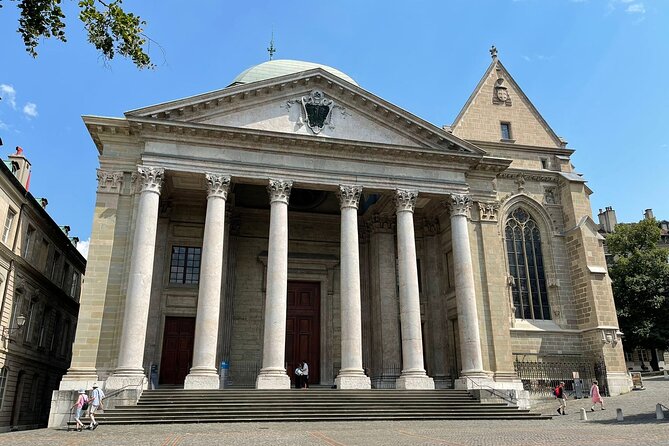
From there, you reach Cathedrale Saint Pierre. This is a Protestant cathedral and has been the main Protestant church in Geneva since 1535. The building story is long: before that it served as the bishop’s cathedral for roughly a thousand years, from the end of the 4th century. The cathedral was rebuilt between the 11th and 15th centuries, with a portal dating from the 18th century.
The quick, practical takeaway: it matters because Geneva’s religious identity shaped the city. If you care about how a city becomes itself, this stop is worth the time.
L’Horloge Fleurie by Lake Geneva, plus Place du Molard and luxury streets
Then it’s time for one of Geneva’s most classic postcard landmarks: L’Horloge Fleurie. The clock sits on the shore of Lac Léman in the English Garden, surrounded by a flower garden that changes design periodically. The detail that makes it special is simple: it’s the only clock that changes colors throughout the year.
This is a short stop, but it’s a good “final photos” moment before the tour wraps into the last historic points.
After that, you see Place du Molard, with the Molard Tower (built in 1591) and the Halles building (1690). The square today is a shopping hub, and it connects directly to Rue de Rhône, a street known for watch and design brands.
I like this because it reflects modern Geneva honestly. The city isn’t stuck in the past. It moves, it buys, it sells, and it still keeps its old structures right in the middle of everything.
Monument National: finishing with Swiss confederation symbolism
The tour ends at the National Monument on Prom. du Lac 2. This is a commemoration of the Union of Geneva to the Swiss Confederation after the restoration of the Republic in 1814.
The monument features statues of Geneva and Helvetia as women warrior figures in an embrace, each with uniforms, crowns, swords, and shields with their symbols.
This final stop is a nice way to close the loop. You started with international institutions and refugee protection. You end with a national moment about union and identity. It’s not the loudest stop of the day, but it fits the theme.
Price, pacing, and practical tips for a smooth half-day
At $252.55 per person, you’re paying for the private vehicle, a guided component, and the structured route that covers a lot without forcing you to do public transport connections across districts. For Geneva, that can be good value because the city can be expensive, and your time is usually the real bottleneck.
Here’s what this price includes that tends to matter:
- Private transportation and an air-conditioned vehicle
- Bottled water provided, plus a quick stop for water or beverages
- Guided walking time (you’ll walk about 2 hours)
- Mobile ticket
- A route built around multiple free-to-see stops, including major outdoor monuments and key public areas
Two practical considerations:
- Bring comfortable shoes. Park paths and Old Town sidewalks add up.
- Plan for light weather flexibility. Umbrellas are not included, and the experience requires good weather. If rain is likely, bring a small umbrella of your own.
One more smart move: if you want souvenirs, do it during the planned shopping windows. The Victorinox and chocolate stops are where you’ll have time to browse without feeling rushed.
Guides matter here too. In the reviews, a guide named Augusto is frequently praised for being friendly, patient, and very focused on connecting the sites to history, religion, politics, and geography. Other guides like Gabriel and Alberto also show up in the experience notes, and the common theme is strong English and a pace that doesn’t steamroll your group.
Should you book this Geneva UN and Old City tour?
If you want a fast, meaningful Geneva overview in one half-day, I think this tour makes sense. It’s especially good for first-timers who want UN campus context plus Old Town must-sees, without spending hours figuring out where everything is.
Book it if:
- You like the idea of understanding what you’re seeing, not just snapping photos
- You want both the UN area and the historic Old City in one outing
- You appreciate built-in breaks, including Swiss chocolate and a chance to buy a customized souvenir
Skip it if:
- You’re hoping for long museum time inside multiple buildings
- You dislike walking (even though it’s manageable for many people, it totals about 2 hours)
- You need lots of indoor, rainy-day flexibility
If you’re on the fence, here’s the simple test: do you want an efficient orientation with high-value stops and a guide who can connect the dots? If yes, this is one of the better ways to spend a Geneva morning or afternoon.
Newly reviewed around Geneva
- Private Trip from Geneva to Yvoire and Évian-Les-Bains in France★ 5.0 · 3 reviews
- Vevey, Montreux, Chillon Day Trip from Geneva★ 4.5 · 44 reviews
- Swiss Vineyard Wine Tasting Tour in Vaud★ 5.0 · 5 reviews
- (KTG302) – Day Trip to Montreux & Château de Chillon from Geneva★ 4.5 · 31 reviews
- Geneva’s Time Capsule: Private tour A Historic Journey★ 5.0 · 4 reviews
- Old Town Geneva Private Walking Tour★ 4.5 · 4 reviews
- Six Hour Private Tour of The Swiss Riviera★ 5.0 · 11 reviews
- Geneva: Riviera Col du Pillon Glacier 3000- High Level Experience★ 4.5 · 26 reviews
City Tours, compared.
City Tour, Cruise, and Lindt Home of Chocolate Visit
Read our review →City Highlights Tour by Bus, Cable Car, and Ferry
Read our review →
City Bus Tour with Audio Guide and Lake Cruise
Read our review →
City Tour with Lake Cruise + Optional FIFA Museum
Read our review →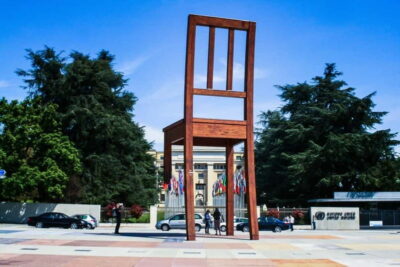
Best of Geneva City Tour: International Area and Old Town
Read our review →
Best of Geneva City Tour with optional boat cruise
Read our review →
Browse the lists this tour appears in