
Reviewed · ZURICH TOURS
Explore Zurich in 60 minutes with a Local
One hour in Zurich can feel like a week. This compact walk is built to get you oriented fast, starting at Zurich city hall and moving through the city’s most recognizable landmarks, from Grossmünster to the famous Chagall windows.
I love how this experience is small and personal, with a maximum of 6 people, so your guide can steer the pace toward what you care about. I also like the mix of what you see plus what you do next, meaning you get practical ideas for cafes, restaurants, and bars along the way.
The only real drawback is time. In just 60 minutes, it is not a deep, hour-long lecture on Zurich’s timeline, so if you want heavy context for every sight, you may finish wanting more.
In This Review
- Key things I’d bet you’ll enjoy
- Zurich in 60 Minutes: what you actually get for $86.16
- Limmatquai to the Rathaus: getting your bearings in real Zurich streets
- Rathaus to Dadaism: politics, art shock, and how the city thinks
- Grossmünster and the Münsterbrücke: skyline icons plus usable photo angles
- Fraumünster and Chagall windows: religious space seen through modern art
- St. Peter’s church clock and the Lindenhof hill: where time gets physical
- Predigerkirche: a Gothic finish and an easy place to continue your day
- Why the local guide tips are the real value
- The itinerary in plain English, stop by stop
- Who should book this one-hour Zurich walk
- Price and logistics: is it worth $86.16 for one hour?
- Should you book this Zurich in 60 minutes experience?
Key things I’d bet you’ll enjoy
- A city-center loop that starts at the Rathaus and ends at Predigerkirche, so you still have an easy path to keep exploring after the tour
- Iconic Zurich stops packed into one hour, including Grossmünster, Münsterbrücke, Fraumünster, and St. Peter’s
- Dadaism as a built-in detour, so you get more than just churches and castles
- Chagall windows at Fraumünster, tied to the way the city feels today
- Views and photo angles from Münsterbrücke, with symmetrical framing you can actually use
- Food and nightlife ideas from your local guide, not just sightseeing talk
Zurich in 60 Minutes: what you actually get for $86.16
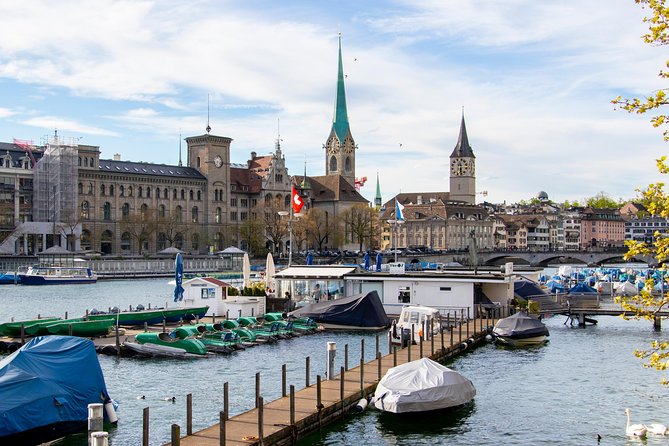
This tour is short by design. You are paying for a guided walking loop that hits the main landmarks without making you read a museum label for an hour straight. At $86.16 per person, it is not a budget bus ride, but it can be good value if you want quick orientation and local recommendations in one go.
You will cover a lot for a single hour, including stops that connect politics, art, religion, and river life. And because the tour is limited to up to 6 travelers, you should expect more interaction than on a big group shuttle.
The ticket delivery is simple with a mobile ticket, and you meet at Limmatquai 55 (8001 Zürich). The tour ends at Predigerkirche, Zähringerpl. 6 (8001 Zürich), so you finish in a central spot that works well for a self-guided follow-up walk.
More things to do in Zurich:
- Lindt Home of Chocolate Museum Entry Ticket
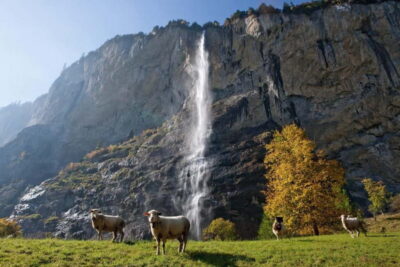
★ 4.7 · 9,329 reviews - Zurich: Grindelwald, Interlaken & Lauterbrunnen Day Trip
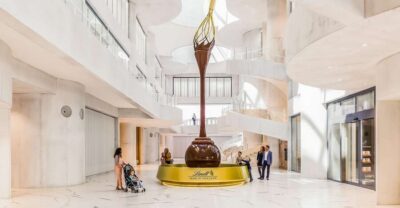
★ 4.6 · 7,123 reviews - Zurich: City Tour, Cruise, and Lindt Home of Chocolate Visit
★ 4.5 · 4,624 reviews
Limmatquai to the Rathaus: getting your bearings in real Zurich streets
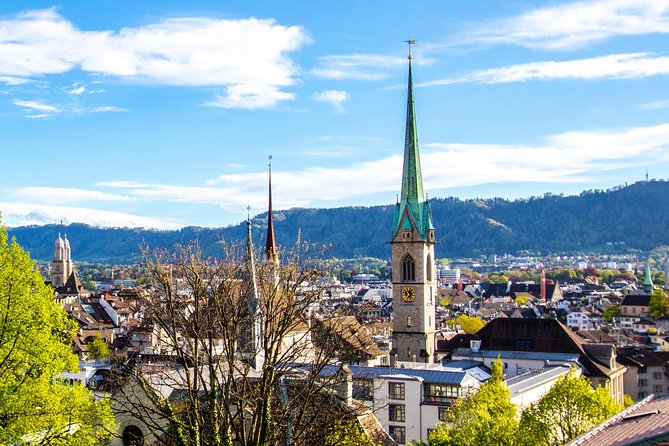
You start on Limmatquai, a classic Zurich river promenade area. From there, the walk leads you to the Rathaus, Zurich’s city hall, where the city’s political legacy shows up with Renaissance charm.
This is a smart first move. City hall is one of the fastest ways to understand where power sits in a place, and Zurich’s identity shows up in the mix of formal civic presence and everyday life around it. Even if you only spend a short time here, you get a framework for what you are seeing next.
A practical note: since this is a walking route, wear comfortable shoes. Zurich streets are made for walking, but an hour can still feel long if you come in with stiff footwear or heavy bags.
Rathaus to Dadaism: politics, art shock, and how the city thinks
After the Rathaus, the tour shifts into something surprising: the birthplace of Dadaism. That stop is less about architecture and more about mindset, the kind that turns Zurich into a place not afraid of creative experiments.
This is one of the reasons I like this route. Many short Zurich tours focus only on postcard churches and river views. Here, you get an art story early on, which helps the rest of the landmarks feel connected rather than random.
Then, the tour swings toward the most recognizable skyline feature in Zurich: Grossmünster. You will see it as a Romanesque marvel with twin towers that define the city’s horizon.
The practical value of this sequence is timing. Seeing Grossmünster after the city hall and Dadaism stops helps you notice Zurich as a city of both tradition and reinvention. You are not just sightseeing, you are building a mental map.
Grossmünster and the Münsterbrücke: skyline icons plus usable photo angles
Grossmünster’s twin towers are the kind of landmark you can spot even if you have never been to Zurich. From a guide, you also get a quick sense of why this building sits at the emotional center of the city, not just as a background object.
Next comes Münsterbrücke, described as having ancient roots and Swiss significance. Bridges are also how Zurich connects districts, and this one is a natural place to pause, reset, and look at the city as a system.
One of the best parts of this stop is the chance to capture Zurich’s charm from the bridge with views framed by a symmetrical design. It is the sort of photo moment that is not automatic. You need to stand in the right place, and a local guide can put you there quickly without wasting time.
A small caution: if it is cold or raining, standing still for photos can feel slow. If the weather is rough, choose a quick photo burst and then keep moving, so you still get the most out of the hour.
Close by, and a different sort of outing:
- From Zurich: Bus Day Trip to Heidiland and Liechtenstein
★ 4.5 · 2,531 reviews - Zurich: City Highlights Tour by Bus, Cable Car, and Ferry
★ 4.4 · 2,366 reviews - From Zurich: Stein am Rhein and Rhine Falls
★ 4.6 · 2,206 reviews - Mount Titlis and Lucerne Day Trip from Zurich
★ 4.5 · 1,960 reviews
Fraumünster and Chagall windows: religious space seen through modern art
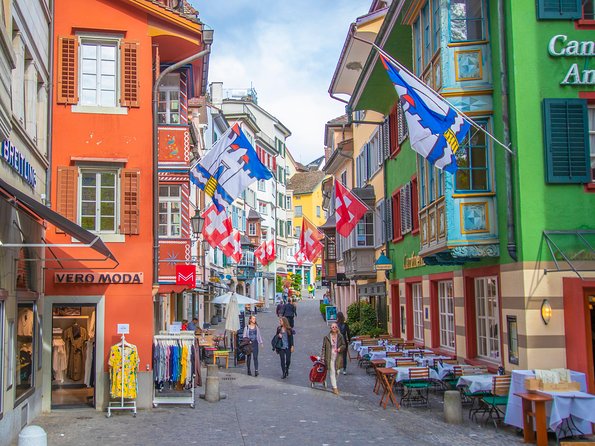
At Fraumünster, you focus on the radiant Chagall windows. Even if stained glass is not usually your thing, these are the kind of landmark details people remember, because they turn a church setting into something visually modern.
What I like about this stop is how it bridges time. The tour uses Fraumünster not only as a pretty building, but as a clue to how Zurich projects itself: old spaces with newer layers of meaning.
You can also think of this as a good midday reset. If you have spent the earlier part of the walk looking at civic and skyline landmarks, Fraumünster gives you a different visual rhythm, with color and light doing some of the storytelling.
St. Peter’s church clock and the Lindenhof hill: where time gets physical
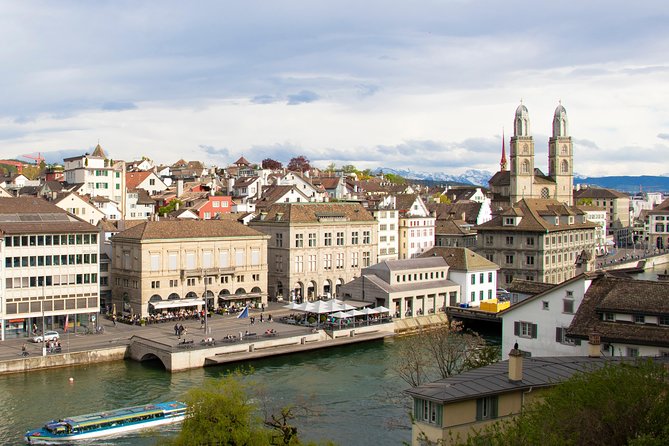
Next on the route is St. Peter’s Church in Zürich, known for Europe’s largest church clock. This is one of those facts that sounds almost too specific to be useful, until you see it and realize it acts like a city character trait. Zurich keeps track of time in a very public way.
Right after that comes Lindenhof, a hill area with fascinating remnants of a Roman castle and a Carolingian Kaiserpfalz that once stood here. You get a sense that Zurich’s story did not start with modern design trends. It layered on top of older eras, and this spot helps you feel that continuity without needing a long museum visit.
A good way to use this portion of the walk is to look at the city from where you stand. Even without extra explanation, a hill viewpoint helps you connect street-level details with how the city is arranged.
Predigerkirche: a Gothic finish and an easy place to continue your day
The tour ends at Predigerkirche, a Gothic church with intriguing history. Finishing at a church makes sense for a walking route, because it is a recognizable landmark and it gives you a clear end point you can return to later if you want.
This ending choice also makes planning your next step easier. The tour wraps up where you can explore the city on your own, so you are not trying to get back to your starting point.
If you are the type who likes to keep momentum, try to build your next stop immediately after the tour ends. Zurich rewards short follow-up walks, and ending near Predigerkirche keeps you in the center of the action.
Why the local guide tips are the real value
The sights are only half the deal. The other half is the local perspective your guide brings to the walk, especially practical ideas for the time you still have in Zurich.
You can expect insider tips on best cafes, restaurants, and bars. That matters because Zurich can be confusing if you only rely on online listings. A good guide can point you toward places that match your vibe, your budget, and the part of the day you have available.
In some short tours, local recommendations feel tacked on. Here, the guide approach is integrated into the walk, which means you do not just leave with a random list. You leave with a sense of what to do next, and how to spend the rest of your limited time in a way that feels like Zurich, not like a checklist.
Also, a small number of people helps these conversations land better. If you ask a question, you are more likely to get an answer that fits your plan rather than a generic suggestion.
The itinerary in plain English, stop by stop
Here is what the full walk is built around, in the order you will see it:
1) Rathaus (city hall)
You start at the Rathaus, where Renaissance charm meets Zurich’s political legacy. This gives you the civic foundation behind the city.
2) Birthplace of Dadaism
Then the tour brings in an avant-garde story. You get a quick perspective on how Zurich has supported creative disruption.
3) Grossmünster
You move to the twin towers that define Zurich’s skyline, a Romanesque icon that anchors your sense of place.
4) Münsterbrücke
You cross to or view from the historic bridge with ancient roots and Swiss significance. It is also a key photo moment.
5) Fraumünster and Chagall windows
You focus on Fraumünster’s Chagall windows, where art changes the feeling of a historic religious space.
6) St. Peter’s Church
You see St. Peter’s Church, home to Europe’s largest church clock. It turns timekeeping into a visible landmark feature.
7) Lindenhof
You finish this major stretch on Lindenhof, with remnants tied to Roman and Carolingian eras.
8) Predigerkirche (Gothic ending point)
The route concludes at Predigerkirche, a Gothic church with intriguing history.
One more important point about the pace: the walk is designed to keep moving. You will get explanations, but you will not linger for long. That is exactly why it works for a first day, and why it might feel rushed if you want to slow down for every building.
Who should book this one-hour Zurich walk
This tour fits best when you want a fast, well-directed overview. I would book it if you are in Zurich for the first time and you want your bearings quickly, including the city’s big landmarks and a few stories that connect them.
It also makes sense if you want a light planning boost. If your main goal is to know where to go next for food and drink, and you want a local lens while you see the sights, this tour is built for that.
I would skip it if your travel style is more about slow, in-depth history. The hour is packed, so you might want a longer tour later if you enjoy deep context tied to every stop.
Price and logistics: is it worth $86.16 for one hour?
Let’s do the value math. You pay $86.16 per person for about 1 hour of guiding, with a small group size (max 6) and a route that hits multiple major landmarks: Rathaus, Grossmünster, Münsterbrücke, Fraumünster, St. Peter’s, Lindenhof, and Predigerkirche.
That can be worth it when you compare it to the alternative of figuring it out yourself, especially if you want local recommendations built into the experience. The mobile ticket also helps, because it reduces hassle when you are juggling multiple things in one day.
One scheduling detail to keep in mind: on average this gets booked about 7 days in advance. If your dates are busy, it is smart to reserve early so you do not end up scrambling for a guide slot.
Should you book this Zurich in 60 minutes experience?
If you want a quick hit of Zurich’s highlights plus real local ideas for food and drink, I think this is a strong yes. The route is designed for orientation, and the small group format makes it feel more personal than a crowded city bus tour.
If you are chasing deep historical context and you like to linger, this might feel too short and too focused on seeing rather than unpacking. For most first-time Zurich visits, though, it is an efficient way to start, then keep the momentum going on your own right after it ends at Predigerkirche.
Newly reviewed around Zurich
- Zurich/Bern/Interlaken/Lucern: Jungfrau & Lauterbrunnen Trip★ 5.0 · 7 reviews
- Zurich: Virtual Reality Arena★ 3.8 · 6 reviews
- Zurich: Stein am Rhein, Rhine Falls & Lake Boat Cruise★ 3.2 · 15 reviews
- Zurich to Rhine Falls: Unforgettable Private Day Trip★ 4.8 · 3 reviews
- Zurich’s best-kept secret: the hidden world of mushrooms!★ 5.0 · 7 reviews
- Zurich: Private tour to Interlaken, Grindelwald & Jungfrau★ 5.0 · 3 reviews
- Zurich: Professional Photoshoot at the Best Spots★ 5.0 · 31 reviews
- Zurich Pub Crawl – Dionysos Zurich Pub Crawl★ 5.0 · 3 reviews
Zurich Tours, compared.
Grindelwald, Interlaken & Lauterbrunnen Day Trip
Read our review →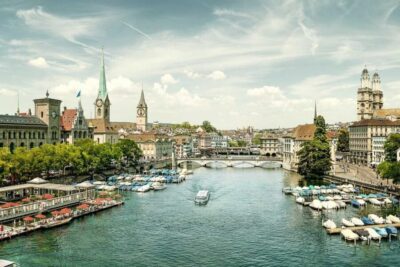
City Tour, Cruise, and Lindt Home of Chocolate Visit
Read our review →
City Highlights Tour by Bus, Cable Car, and Ferry
Read our review →
Mount Titlis and Lucerne Day Trip from Zurich
Read our review →